
Death toll tops 1,900 as Haitians dig by hand for survivors, hope for more rescue help
As rain from Tropical Storm Grace continued to pelt earthquake-shattered towns on Tuesday, some Haitians were growing frustrated with the slow pace of aid. In many places, residents and rescue workers were using their bare hands and shovels to search for survivors in collapsed buildings.
In Les Cayes, the heavily damaged port town in Southwest Haiti, a methodical rescue effort was underway at a toppled apartment building in the neighborhood of Bonfret. A woman trapped deep in the rubble had earlier been in touch with rescuers by phone. Whether she was still alive Tuesday morning was unclear, but rescuers reported sounds emanating from underneath a mound of concrete.
“We are not going after dead people. We are hoping everyone is alive,” said Adler Lubin, a public works administrator who was helping lead rescue efforts alongside Haitian soldiers and civil protection workers.
Still, the building had already claimed 10 lives. One couple reported they lost three children in the collapse. Rescuers pulled two of the children from the rubble — on Tuesday morning, the corpse of a 3-year-old girl was on the ground, covered in a tarp, waiting for the Red Cross to remove her body.
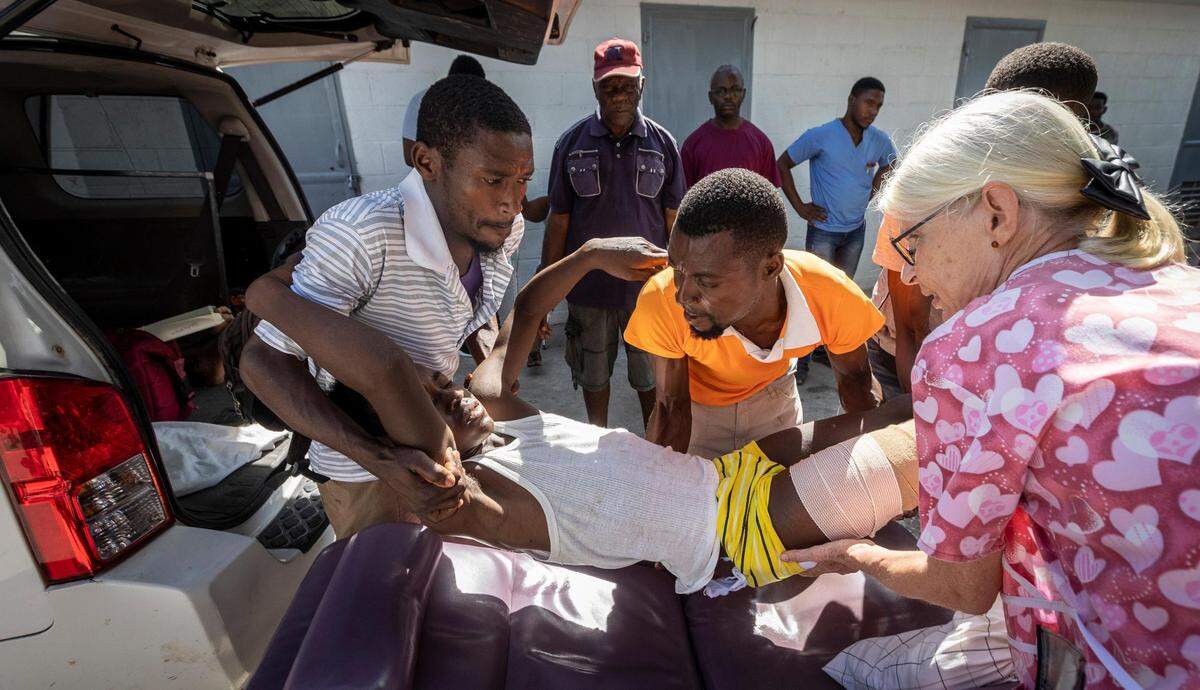
The pace of rescue and aid efforts was frustratingly slow three days after the 7.2 magnitude earthquake devastated the southwestern Tiburon peninsula of Haiti, killing at least 1,941, injuring more than 9,000 and toppling or damaging thousands of structures and homes.
Les Cayes, which is about 120 miles southwest of the capital of Port-au-Prince, was the scene of desperation Tuesday.

Some of the streets were flooded from Grace’s passage. Under the driving rain, Haitians waited in lines at money-transfer businesses, hoping to get money from relatives in South Florida. Young men picked through debris at Le Manguier, a hotel that collapsed during Saturday’s quake, killing Gabriel Fortuné, a longtime Haitian lawmaker and former mayor of Les Cayes.
At the town’s general hospital, patients overflowed the rooms. Some had avoided the winds and rain by sleeping in a covered walkway. They complained about the lack of tents and medication.
“If the rain or earthquake doesn’t kill you, the lack of healthcare will,” said Wilson Chery, who found refuge at the hospital from a nearby mountainous region that was largely inaccessible to rescuers.
Another medical facility, the 120-bed Hospital Lumiere in the nearby mountain village of Bonne Fin, partially collapsed in the quake. Patients have been evacuated and are under tents nearby. Thankfully, no one was injured or died at the site. Normally, the hospital can do 50 elective surgeries per day — but a roof failure destroyed its four operating rooms, four anesthesia machines and surgical equipment.
Tom Hitz, a board member for the hospital run by by the Evangelical Baptist Mission of Southern Haiti, said doctors need a mobile operating room.
“We need tents,” Hitz said Tuesday. “We can sterilize. We can wash all of our instruments. We have a boiler, we can create steam. We just need an operating room.”
Reports of casualties across the peninsula continued to mount after the passage of Tropical Storm Grace. In the Grand Anse province town called Beaumont, 27 people have died and 50 were injured after a landslide Tuesday morning, according to New Life for Haiti, a Christian charity based in the region.
“Roads are completely blocked this morning, even to motorcycles, due to landslides, so the people my organization serves are cut off from any help, other than that which can be flown in,” Marnie Van Wyk, the executive director, wrote in an email.
The U.S. government is also setting up a base of operations in the town. USAID disaster response teams had to temporarily suspend operations late Monday because of Tropical Depression Grace, but were slated to return Tuesday to Les Cayes.
“The team reports that food, healthcare services, safe drinking water, hygiene and sanitation, and shelter are all priority needs,” said John Morrison, a member of the urban search-and-rescue team from the Fairfax County Fire and Rescue Department that has joined the USAID response team.
A USAID official said that “much more” assistance for Haiti from the international community “will be needed in the coming days and weeks.” But while U.S. officials said they expect the death toll to climb, they do not believe the scale of the disaster will prove comparable to the catastrophic earthquake of 2010.
With armed gangs prevalent throughout Haiti, concerns about security have also been pressing for aid workers and emergency personnel. A senior Biden administration official said extra “regional security officers” had already been in Haiti because of the July 7 assassination of Haitian President Jovenel Moise, and the U.S. government was coordinating regularly with Haitian National Police “to manage the security situation.”
Military personnel from the Doral-based U.S. Southern Command have been involved in rescue and relief efforts.
The U.S. Coast Guard reported Tuesday that it had saved 51 people and transported 5,500 pounds of medical supplies into the country. Army helicopters are also being brought in to help move supplies, as is an amphibious support ship that can host helicopters, U.S. Air Force Lt. Gen. Andrew Croft, Southcom’s military deputy commander, told WLRN.
The U.S. Navy has also been using a drone to do reconnaissance to inspect roads and airfields.
Administration officials signaled that a wide deployment of troops — like what happened after the 2010 earthquake in Haiti — isn’t in the works yet. In a White House press briefing Tuesday, National Security Advisor Jake Sullivan stressed “there are no current plans to speak of to deploy U.S. military personnel to Haiti.”
Asked about frustrations over the slow pace of recovery, a State Department official said that Prime Minister Ariel Henry has expressed thanks and appreciation to the U.S. Ambassador for the American efforts.
Still, relief organizations were scrambling to try to get help to Haitians affected by Saturday’s quake.
“I’ve been working on evacuations all day,” said Britnie Faith Turner, of disaster relief firm Aerial Recovery Group, who is in Haiti helping coordinate helicopter flights ferrying patients to hospitals in Port-au-Prince. “I watched several people die. We’re doing all we can. It’s a very hard situation.”
Dr. Larry Pierre, the executive director of the Center for Haitian Studies, a Miami-based nonprofit founded in 1989 that provides health and social services, has donated two dozen beds for Haiti earthquake relief efforts. The beds, which had been sent before the quake hit the southern parts of the Caribbean nation, are in the process of being transported to hospitals.
The organization is trying to conduct relief work in a “more orderly fashion” compared to the 2010 earthquake, he said, to ensure that it is filling actual needs, adding that some supplies donated last time were eventually put in storage.
“We are trying to avoid the waste that goes on with this kind of thing,” Pierre said, adding that the group is planning to send more beds and supplies later this week. “It depends on how much we can ship and what the needs are. We’ll see.”
The supplies are desperately needed in places such as Fleurant, a rural and muddy village on the outskirts of Les Cayes, where nearly every house, a church and even a cemetery were damaged by the quake. Many houses had completely pancaked. Others had walls and roofs blown out. The town is in the hard-hit Nippes region near the quake’s epicenter.
“Everything we had is underneath the rubble,” said Elize Civil, 30. “We don’t have anything,” he said. ”All of the houses have been destroyed. There are no houses. ... We need a lot of help.”
As he spoke residents were going through the rubble trying to salvage rusted zinc sheets, hoping to use them to make shelters against Grace’s rain.
“We don’t have tarps to make a shelter,” said Clermont Chavannes, 34. “We need temporary shelter. You can’t sleep. Even food doesn’t interest you.”
This story was originally published August 17, 2021 at 1:03 PM.